[mxchat_chatbot floating="yes" bot_id="contentbot1"]
Screenshot-2024-01-12-11.10
Witch Store
Blog
Social Links
LogIn / LogOut
Shopping Cart

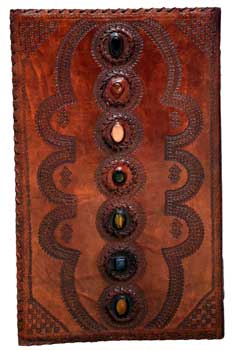
Large Leather Blank Book of Shadows with 7 Chakra Stones

If you have ever wanted a leather blank book with real presence, one that feels more like an heirloom than a notebook, this is the one to look at. Our 14" x 22" 7 Stone leather blank book is the biggest tome we have offered, built for practitioners who want a single, substantial home for their writing, sketches and records.

Large leather book with a row of seven colorful stones on its cover resting on a candlelit wooden altar

What Makes This Tome Different

The first thing you notice is scale. At 14 inches by 22 inches, it is closer to a ceremonial volume than a pocket journal. The cover is made from goat leather and features an Indian-inspired design in the center, with a line of seven chakra stones running down the front.

Here is what the product details tell us:

  • Size: 14" x 22", though dimensions may vary slightly because each book is handmade.
  • Pages: 400 blank, handmade linen parchment paper pages.
  • Thickness: just over 4 inches, which matters when you plan shelf space.
  • Cover: goat leather, with embossing at the edge and on the rear cover that may vary from book to book.
  • Closure: no latches and no cord to tie it shut.

Because the embossing and size can differ slightly, expect yours to have its own character rather than being an exact copy of a photo.

The Seven Stones and Their Traditional Associations

Many modern practitioners link seven stones in a row with the chakra system, which comes from Indian spiritual traditions and describes energy centers along the body. In the way many people use this idea, each stone is tied to a different center and a different theme, such as grounding, creativity, voice or intuition.

Whether you work with chakras closely or simply love the look, the stones give the cover a clear focal point. Some owners may enjoy touching the stones as a quiet moment of focus before they begin to write. That is a personal practice, not a guarantee of any outcome.

Using It as a Handmade Book of Shadows

A book this size suits a handmade book of shadows or a grand grimoire that stays in one place. Traditionally, a Book of Shadows is a personal record of rituals, correspondences, dreams and lessons learned. With 400 blank pages, there is plenty of room to grow over many years.

Ways people might fill a book like this:

  • Seasonal rituals and notes for each sabbat
  • Moon phase observations and journaling
  • Herb, crystal and candle correspondences
  • Spell wording, results and reflections
  • Sketches, sigils and pressed paper keepsakes
  • Tarot spreads and the insights that came with them

If you are new to the idea, our guide on starting a Book of Shadows has page ideas to help you plan your first entries.

Who This Book Is For

This tome may suit you if you want a display-worthy centerpiece for your altar or study, or if you like to write slowly and at length. It also fits those who want one master volume to copy their favorite work into, rather than scattered notebooks.

It may not suit you if you want something to carry in a bag. The description is clear that it is not meant for travel, and with no latches or cord it is best kept flat or upright on a sturdy shelf or table.

What to Know Before You Choose

Check your space

At just over 4 inches thick and 22 inches tall, this book needs a solid surface. Measure your shelf or altar before ordering.

Plan your writing tools

The pages are handmade linen parchment paper, which has its own texture. Test your favorite pens on a scrap of similar paper if you can. Handmade paper can react differently to different inks.

Keep it away from flame and smoke

If your practice includes candles, incense or smoke cleansing, keep them well away from the leather and paper. Never leave a flame unattended, and keep burning items clear of pages. If you or anyone in your home has allergies or asthma, or you are pregnant or have pets, check that incense and herbs are suitable before using them near your workspace.

Accept the handmade variations

Embossing, sizing and details will vary a little. That individuality is part of a handmade item.

Making It Your Own

Some practitioners like to bless or dedicate a new book before the first entry, perhaps with a few quiet words, a moment of meditation or a simple intention written on the first page. There is no required method. Do what feels respectful and meaningful on your path.

A large leather blank book like this invites you to treat your practice as something worth preserving, whether you walk a Wiccan, eclectic or other magical path.

Frequently Asked Questions

Does this book have a clasp or cord?

No. There are no latches and no cord to tie it closed, so it is meant to rest on a shelf or table.

Are the pages lined?

No. The 400 handmade linen parchment pages are blank, which leaves you free to write, draw or design layouts as you like.

Can I take it with me when I travel?

It is not designed for travel. At 14" x 22" and just over 4 inches thick, it is best kept at home as a permanent volume.

See 14"x22" 7 Stone leather blank book in the shop →


Follow Rare Wiccan Spells: Facebook • Instagram • Pinterest • YouTube • eBay Store

Spellwork Journal: What to Record and Why It Matters

A spellwork journal is one of the simplest tools a witch can keep, and one of the most useful. Whether you are casting your first candle spell or have practiced for decades, written records turn scattered experiences into real understanding. In this post, we will walk through what to record, why it matters, and how to build a habit that suits your own path.

Why Keep a Spellwork Journal?

Memory is slippery. A week after a ritual, you may forget which herbs you used, what the moon looked like, or how you felt halfway through. Writing it down gives you something to return to.

Here is what a journal can offer:

  • Learning: You can see what you did and notice patterns over time.
  • Refinement: You can adjust wording, timing or tools and compare the difference in your own experience.
  • Continuity: Your practice becomes a story you can follow across seasons.
  • Honesty: Notes help you reflect clearly instead of relying on hopeful recollection.

Many practitioners see journaling as part of the craft itself, a way of giving attention and intention to what they do. Results are never guaranteed in any tradition, so a journal is less about proving outcomes and more about understanding your own practice.

What to Record in Your Spellwork Journal

You do not need to write an essay each time. A short, consistent set of details is often more helpful than long entries you never finish.

The Basics

  • Date and time of the working.
  • Moon phase and, if you like, the day of the week or season.
  • Your intention, written in one clear sentence.
  • Type of working, such as a candle spell, charm, meditation, or tarot-guided ritual.

Materials and Setup

  • Candles, herbs, oils, crystals, incense or other items used.
  • Ritual tools and how you arranged your altar or space.
  • Any substitutions you made, and why.

The Working Itself

  • The words you spoke, or a note about where the wording came from.
  • Steps in the order you did them.
  • How you opened and closed the space.

Your Experience

  • How you felt before, during and after.
  • Any images, thoughts, dreams or synchronicities that followed.
  • Anything that felt awkward or did not go to plan.

Follow-Up Notes

Leave space to return a few days or weeks later. Record what changed, what stayed the same, and what you might do differently. Be gentle and honest: some workings feel significant, others feel quiet, and both are worth noting.

Simple Entry Template

If you like structure, try this quick format and adapt it as you go:

  • Date / moon phase
  • Intention
  • Materials
  • What I did
  • How it felt
  • Follow-up (one week, one month)

Keep it brief on busy days. Even three lines is better than none.

Spellwork Journal vs. Book of Shadows

Many people ask whether a journal and a Book of Shadows are the same thing. They overlap, but they often serve different purposes. A Book of Shadows or grimoire traditionally collects spells, correspondences, rituals and lore you want to keep. A spellwork journal is more like a logbook of what you actually did and how it went.

Some witches combine both into a single volume, while others keep two. You might draft a spell in your journal, refine it over several attempts, and then copy the final version into your Book of Shadows. There is no single right way, so choose what feels practical. If you enjoy a keepsake-quality book for this, you can explore handmade Books of Shadows.

Tips for Making the Habit Stick

  • Write soon after the ritual, while details are fresh.
  • Keep your journal near your altar so it becomes part of the closing step.
  • Use whatever format suits you: a notebook, loose pages, or a binder. Some people like printable spell pages to keep entries tidy.
  • Review monthly or at each sabbat to look for patterns.
  • Do not judge yourself. Your journal is a learning space, not a report card.

A Quick Safety Note

If your records involve herbs, oils, incense smoke or candles, note any allergies or sensitivities you discover, and keep notes on fire safety, such as using a stable holder and never leaving flames unattended. Pregnancy, pets and children are also worth considering when you burn or handle botanicals, and a healthcare professional or vet can advise on specific concerns. Your journal can be a handy place to keep these reminders.

Your Journal, Your Practice

A spellwork journal does not need to be beautiful or perfect. It needs to be honest and useful to you. Over months and years, it becomes a personal record of how your practice has grown, with lessons you earned yourself.

If you would like to gather supplies for your next working or find a lovely place to record it, we invite you to browse our shop and see what speaks to you.

Frequently Asked Questions

How often should I write in my spellwork journal?

Write an entry after each working, even a short one. If you practice daily, a few lines is plenty, and you can save longer reflections for the full moon or a weekly review.

Should I record spells that did not seem to work?

Yes. Those notes can be some of the most valuable. They help you spot changes in wording, timing or mindset, and they keep your records realistic rather than only celebrating the highlights.

Do I need a special notebook?

No. Any notebook or digital document will do. Some practitioners prefer a dedicated, beautiful book because it makes the habit feel special, but consistency matters far more than the cover.


Follow Rare Wiccan Spells: Facebook • Instagram • Pinterest • YouTube • eBay Store
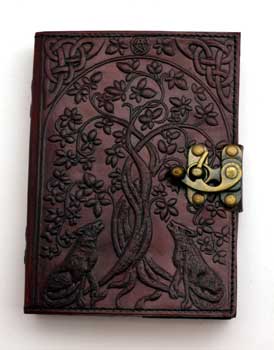
Leather Blank Book with Wolves and Tree of Life

A good leather blank book can become the heart of a magical practice. Our Wolf & Tree of Life leather blank book with latch is a sturdy, handsome journal with 240 unlined pages, ready for whatever you wish to record. Below we look at what makes it special, who it may suit, and what to consider before choosing a journal like this.

What Makes This Leather Blank Book Stand Out

The first thing you notice is the front cover. It is tooled and embossed with a central Tree of Life, and at the base of its trunk a pair of howling wolves. An arch is embossed above the tree, with Celtic knot patterns bordering the top corners and a pentacle at the very top center.

The back cover carries an embossed diagonal design. Along the spine edge you will find decorative leather cross-stitching, and a solid bronze-colored metal latch holds the book closed so its pages stay protected.

Key Details at a Glance

  • Material: leather with tooled, embossed artwork
  • Size: 5 inches by 7 inches
  • Pages: 240 blank, unlined pages
  • Closure: solid bronze-colored metal latch
  • Format: a physical book, not a digital download

The Symbolism on the Cover

Many practitioners choose a journal because its imagery speaks to them. Here is how these symbols are often understood in general terms, though your own meaning matters most.

Tree of Life

The Tree of Life appears in many cultures as a symbol of connection between earth, sky and the underworld, and of growth and continuity. In witchcraft it is often used as a reminder of how all things are linked.

Wolves

Wolves are commonly associated with instinct, loyalty, the pack and the moon. A howling wolf is a popular image among those who feel drawn to lunar work or to wild, nocturnal energy.

Celtic Knots and the Pentacle

Celtic knotwork is often read as a symbol of interwoven paths and continuity, since the lines have no beginning or end. The pentacle is a widely used emblem in Wicca, often connected with the five elements of earth, air, fire, water and spirit.

How Practitioners May Use It

Because the pages are unlined, you can write, sketch, draw sigils or map out charts without a printed grid in the way. Some ideas include:

  • A handmade book of shadows for rituals, correspondences and personal reflections
  • A grimoire for wiccan spells you have written or adapted yourself
  • A moon journal tracking phases, dreams and observations
  • A tarot diary for daily draws and spreads
  • A record of seasonal celebrations and sabbat notes

If you are new, our post on starting a book of shadows offers page ideas that pair well with a blank journal like this one. There is no single correct way to keep a magical book, and many people simply begin with what feels meaningful.

What to Know Before Choosing

A few practical thoughts may help you decide whether this book suits you:

  • Size: at 5 by 7 inches it is compact enough to carry yet roomy enough for a personal practice. If you like large diagrams, you may prefer a bigger format.
  • Unlined pages: these are wonderful for art and free-form notes, though some writers prefer lines for neatness.
  • Ink choice: test your favorite pen on a back page first, since different inks behave differently on different paper.
  • Care: keep leather away from damp conditions and direct heat. If you plan to burn candles or incense nearby, keep flames and smoke well away from the book, and never leave a flame unattended. Some people are sensitive to leather or to the herbs and oils used in ritual, so consider allergies, pets and children in your space.

Who Is This Journal For?

This book may appeal to Wiccans, eclectic witches, pagans and anyone who loves nature symbolism. It could also be a thoughtful gift for a fellow practitioner, or a lovely way to mark the start of a new chapter in your craft. If you are exploring witchcraft supplies, a well-made journal is one of the most personal ritual tools you can own, since it fills with your own words over time.

Choosing a leather blank book is ultimately a matter of what inspires you to open it and write. Its imagery, latch and generous page count make this one a fitting companion for a lasting magical record.

Frequently Asked Questions

How many pages does this book have?

It contains 240 blank, unlined pages, giving plenty of room for spells, notes, drawings and reflections.

What size is the journal?

It measures 5 inches by 7 inches, a handy size for both home use and carrying with you.

Can I use it as a book of shadows?

Yes, many practitioners use a blank leather journal as a book of shadows or grimoire. It is a personal choice, and you can fill it in whatever way suits your path.

See Wolf & Tree of Life leather blank book w/ latch in the shop →


Follow Rare Wiccan Spells: Facebook • Instagram • Pinterest • YouTube • eBay Store

Start a Book of Shadows: First Steps and Page Ideas

If you want to start a Book of Shadows, you are joining a long tradition of keeping a personal record of your craft. A Book of Shadows is simply a witch's own journal or grimoire, a place for spells, rituals, correspondences, dreams and reflections. There is no single correct way to make one, and you do not need expensive materials to begin. This guide walks you through the basics in plain language.

What Is a Book of Shadows?

In many Wiccan and witchcraft paths, a Book of Shadows is a working notebook of your practice. Some traditions pass down shared texts within a coven, while many solitary practitioners build their own from scratch. You may also hear the word grimoire, which is often used for a book of spells and magical knowledge. Many modern witches use the two terms loosely, and some keep both: a Book of Shadows for personal practice and a grimoire for reference.

What matters is that it is meaningful to you and useful in your practice.

Before You Begin: Choose Your Format

The first decision is what kind of book to use. Each option has its own charm.

  • A bound blank book or journal: Feels special and permanent, but mistakes are harder to fix.
  • A three-ring binder: Lets you add, remove and reorder pages as your practice grows. Many beginners find this the most forgiving choice.
  • A digital document or app: Easy to search and back up, though some people miss the tactile feel of pen on paper.
  • A handmade or custom book: A lovely choice if you want something crafted with intention. You can browse handmade Books of Shadows for inspiration.

Many people begin with a simple binder or notebook and move their favorite pages into a finer book later. This is a very common and sensible approach.

How to Start a Book of Shadows in Five Steps

1. Set your intention

Take a quiet moment and ask yourself what you want this book to be. A record of learning? A spell workbook? A spiritual diary? Write a sentence or two on the first page. You might also add a dedication or a short opening blessing in your own words.

2. Decide on a simple structure

You do not need a perfect system, but a few sections help you find things later. Common sections include:

  • Moon phases and the Wheel of the Year
  • The elements and the directions
  • Correspondences for herbs, crystals, colors and candles
  • Spells and rituals you have tried or want to try
  • Divination notes, including tarot spreads and dream records
  • Personal reflections and lessons learned

Leave a few blank pages between sections so you have room to grow.

3. Write your first entries

Start with what you already know or are currently learning. Good first pages include a note on your path and why you are drawn to it, the date and moon phase of your first entry, and a summary of one concept you studied this week. If you are new to the path, notes from your reading on Wicca for beginners make a wonderful foundation.

4. Record your workings in a consistent way

When you perform a ritual or spell, note down the date, moon phase, your purpose, the tools you used, the steps you followed and how it felt. Later, add what you observed. Treat these as personal records of your practice rather than guarantees of outcomes. Over time, you will see patterns in what resonates with you.

5. Make it yours

Add sketches, pressed leaves, symbols you love, or a personal sigil. Some witches write in a special script or ink; others prefer clean, clear handwriting. If you want ready-made layouts to tuck into a binder, printable spell pages can save time, and you can look at the free spell downloads to try a few first.

Tips for Keeping It Going

  • Write in pencil first if you worry about mistakes, then copy the final version in ink.
  • Cite your sources. Note where a spell or correspondence came from, so you can revisit it. Write your own versions in your own words rather than copying books word for word.
  • Keep it private if you wish. Your book is personal, and you can decide who sees it.
  • Review it each season. Reading older entries shows you how far you have come.

A Gentle Safety Note

Many spells involve candles, herbs, incense or oils. Never leave a burning candle unattended, keep flames away from your book and other flammable items, and use a heatproof holder. Some herbs and essential oils can irritate skin or trigger allergies, and some are unsafe for pets, children or during pregnancy. Research any ingredient carefully, and check with a qualified professional if you have health concerns. When recording a working in your book, noting your safety precautions is a good habit too.

There Is No Wrong Way to Begin

Perfectionism stops many people from starting. Your first pages do not need to be beautiful or profound. When you start a Book of Shadows, you are simply beginning a conversation with your own practice, and it will grow with you. Fill it slowly, revise it often and let it reflect who you are.

If you would like some help along the way, we invite you to explore our shop for tools, books and pages to support your journey.

Frequently Asked Questions

Do I need to buy a special book to start?

No. A simple notebook or binder works well. Many practitioners start plain and later transfer their favorite entries into a more decorative book.

What should I write on the very first page?

Many people write a dedication, their name or craft name, the date, and their intention for the book. Others begin with a short blessing or a quote they wrote themselves.

Is a Book of Shadows the same as a grimoire?

They overlap. A Book of Shadows is often a personal journal of practice, while a grimoire is traditionally a collection of spells and magical knowledge. Many modern witches use the terms interchangeably.


Follow Rare Wiccan Spells: Facebook • Instagram • Pinterest • YouTube • eBay Store

Scroll to Top

Subscribe